Umbrellas and Sunshine
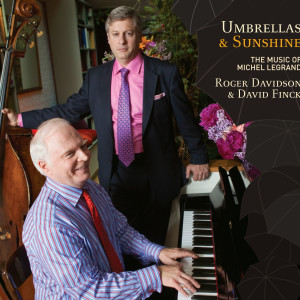
French composer Michel Legrand has written some of the most memorable romantic music on film. Many of his songs have long since become jazz and pop standards. In Umbrellas and Sunshine, pianist and composer Roger Davidson and bassist David Finck offer a deeply original, intimate take of Legrand’s music – stories of love found and lost, elegantly whispered, swinging, among friends.
Since starting his career in the ‘70s, French-American pianist and composer Roger Davidson has been as voracious in his musical curiosity as Michel Legrand — and just as fearless in his reach. Davidson’s writing include symphonies and choral music, small-group jazz, Klezmer, tango and a bounty of Brazilian-flavored songs. In all his work, as in Legrand’s, melody reigns. It was bassist David Finck, who suggested to Davidson exploring an album’s-worth of Legrand’s songs. The pianist was all for it.
“I feel a tremendous kinship with Michel Legrand,” says Davidson. “Legrand is French, and so am I. He is a very romantic composer; he writes music with feeling. We both love to write melodies. Like everyone else, I heard his tunes played over and over by many wonderful musicians, and I started playing them myself.” The result is Umbrellas and Sunshine, a celebration of Michel Legrand, romance, and swing.
Reviews
Michel Legrand is an award-winning composer that has scored a myriad of music for film, television and stage. Active for decades, among his best known film works include The Thomas Crown Affair, Summer of ’42, Best Friends and Yentl. He also did the music for Orson Welles’ last completed film F for Fake. The legendary French composer continues to cross a number of paths in his musical diversity, always retaining at the core a deeply reflective passion and romanticism.
Davidson and Finck seem to connect with those notions of passion and are sensitive to the nuances that truly make Legrand an original. The duo bring their own style and substance to many of these film pieces and offer a fresh and vibrant take on some familiar and indelible themes. The overall ambience of this disc is one of relaxed sophistication. As the listener you kind of feel like you’re sitting in some very upscale lounge or tapas bar sipping on a well-made libation without a care in the world. Davidson has a style reminiscent of Bill Evans or Andre Previn and, on many of the compositions here, finds the perfect balance between reharmonization and a faithfulness to the original work. Examples of this can be found in the opening piece “Les Parapluies De Cherbourg” from the French film The Umbrellas of Cherbourg. The duo really swing on this familiar theme, weaving in and out of solos seamlessly but never overshadowing the beauty of the main melody. Other highlights include the interesting manner in which Davidson manipulates the ever shifting modulations on “Les Enfants Qui Pleurent.” He does it so effortlessly and provides some nice solo opportunities for Finck. “The Summer Knows” is another familiar romantic piece. Davidson employs tension and drama in the way he alternates from major to minor modes. It’s a wonderful melody that is further enhanced by Finck’s orchestrated bass bow technique. “Watch What Happens” is a tune that often tends to be performed as a samba. But here it lithely swings like crazy. Finck’s bass lines make this piece jump in a playful yet smooth manner. Davidson states in the liner notes that, being of French descent himself, he felt a certain kinship to Legrand in taking on this musical assignment. Merci beaucoup to a job well done!
By Eric Harabadian
52 April 2011 • Jazz Inside™ Monthly • www.jazzinsidemagazine.com
_____________________________________________________________
There aren't many living legends walking among us, let alone playing 12 sets this week at the Blue Note. Ironically, the most acclaimed composer of the "traditional" Great American Songbook in the last 40 years is this copiously decorated Frenchman. Mr. Legrand has not only written more tunes you grew up with than anyone else alive, he plays them with a technique that suggests Oscar Peterson and Bach simultaneously, driven by heavily swinging runs in baroque counterpoint. The 79-year-old composer has, no less miraculously, recruited two of the only rhythm players who can keep up with him, the Parisan bassist François Moutin and hometown hero Lewis Nash on drums.
Appreciation of Mr. Legrand's music is heightened by the release of the excellent "Umbrellas and Sunshine" by fellow French pianist Roger Davidson and the formidable New York bassist David Finck in a rare co-starring role. Put brilliant musicians together with great music and watch what happens.
Will Friedwald
Wall Street Journal
http://online.wsj.com/article/SB10001424052748703712504576234923926338478.html?mod=googlenews_wsj
____________________________________________________________
The songs of Michel Legrand have attracted a multitude of jazz musicians over the years. ROGER DAVIDSON, a pianist and composer in a wide ranging variety of musical genres, and who comes from a mixed French and American heritage, has turned his attention to Legrand’s melodies for his most recent recording. Umbrellas & Sunshine (Soundbrush – 1019) is a duo effort from Davidson and bassist David Finck that wonderfully captures the beauty and spirit of Legrand’s music. Legrand has also spent part of his impressive career in the world of jazz, and has imbued his songs with the kind of structure that adapts naturally to jazz interpretations. Davidson and Finck are frequent and well matched partners who often sound like one mind in two bodies. With the ballads they are appropriately tender, and when the pace quickens, their easy sense of swing makes you feel the movement in their music. One of Legrand’s most well known pieces is “How Do You Keep the Music Playing?” One way is to have two fine creative musicians turn their attention upon songs like the ones by Legrand that can be found on Umbrellas & Sunshine. (www.soundbrush.com)
Review By Joe Lang - Jersey Jazz
_____________________________________________________________
Many people never take the time to truly say how they feel about important people in their lives until it's too late. The same holds true in the jazz community. Posthumous tributes pour out of magazines, newspapers and websites, and are delivered via recordings when important figures of the music pass on, but something resonates more deeply when an artist is still around to receive these plaudits. The great Johnny Mandel recently received such an honor when the DIVA Jazz Orchestra, under his baton, recorded and released a live set built around his compositions, and now another composer of note--pianist Michel Legrand--receives his due, through these delightful duo readings from pianist Roger Davidson and bassist David Finck.
While Legrand's lush language and sweeping sense of romanticism and drama come through on many performances here, that doesn't account for all of the material. Perky piano and jovial walking bass lines meet in mutual satisfaction (”Watch What Happens”), while Davidson is at his seductive best on a solo run through of the lesser-known “Look,” and a bouncing, happy-go-lucky sense comes over this swinging pair on “Les Parapluies De Cherbourg.” When Davidson reprises this piece as a solo work at album's end, his penchant for Latin jazz is heard loud and clear.
Those who prefer the Legrand songs that connect like love letters, causing the body to swoon in recognition of their contents and requiring a tissue in hand to dab the gently falling tears, will also find plenty to love. Finck's spine-tingling arco on “The Summer Knows” is a good match for the dramatic arc that Davidson paints, and “The Easy Way/What Are You Doing The Rest Of Your Life?” is a haunting work that lingers long after it ends. The pair reaches a peak in emotional resonance on one of Legrand's better known works, “How Do You Keep The Music Playing?,” “which serves as a finale of sorts, before Davidson delivers a coda with his reworked “Les Parapluies De Cherbourg.”
Davidson and Finck cover Legrand in grand fashion and with any luck the maestro himself will have an opportunity to hear such things.
By Dan Bilawsky - All About Jazz
http://www.allaboutjazz.com/php/article.php?id=38890
_______________________________________________________________
Umbrellas and Sunshine is a captivating collection of twelve of Michel Legrand’s pieces arranged and performed on piano and bass by Roger Davidson and David Finck. Many of the songs are Legrand’s most famous, played in an elegant style and paced at a relaxed, easy tempo. The rhythms and harmonies are rich and honor Legrand’s original melodies while providing a fresh new take on some the composer’s best music to date. Davidson shares Legrand’s French heritage and feels a true kinship with him and his passionate approach to composing memorable, deeply-felt songs. Davidson also shares a voracious curiosity about music and has ventured into many diverse genres that include tango, Brazillian, and klezmer as well as symphonic and choral. David Finck has collaborated with Davidson on many other projects, and the two present a seamless unity as a duo. Finck’s occasional solos are evocative and beautiful.
Umbrellas and Sunshine opens with “Les Parapluies de Cherbourg” (“The Umbrellas of Cherbourg”), which is better known in the US as “I Will Wait For You.” Upbeat and optimistic, the artists set the mood of the album with one of Legrand’s masterpieces. “La Valse Des Lilas” (“Waltz of the Lilacs”) is smooth, graceful, and full of longing. Finck has a couple of wonderful solos, playing his bass pizzicato. Although the title of “Les Enfants Qui Pleurent” (“The Children Who Cry”) seems heartbreakingly sad, this lively piece gently dances for joy. “The Summer Knows,” the theme from The Summer of ’42, is one of the most beautiful songs ever written and has been performed and recorded countless times over the years. Davidson and Finck make it their own, conveying an unforgettable depth of emotion. Finck’s bass solo is amazing! “Watch What Happens” has become a jazz standard, and this arrangement is rhythmic and carefree. Another favorite is the medley of “The Easy Way” and “What Are You Doing The Rest of Your Life?” Pairing one of Legrand’s lesser-known songs with one of his most popular adds a bit of a surprise while creating an emotional powerhouse. “You Must Believe in Spring” is a graceful ballad that flows from the heart. “Look” is another beautiful but lesser-known song that Davidson captured as a tender piano solo in one take. “How Do You Keep the Music Playing?” is Legrand’s most recent “hit.” Frequently performed and recorded, Davidson and Finck again make it their own with deep expression and tangible emotion. The closing track is a reprise of “The Umbrellas of Cherbourg,” recorded as a piano solo when Roger Davidson didn’t know he was being recorded. More poignant than the opening version, it’s a superlative ending to a fantastic album.
I have to admit that Michel Legrand has always been one of my favorite songwriters, and I truly think this is the best collection of his work that I’ve heard. It is available from www.rogerdavidsonmusic.com, Amazon, iTunes, and CD Baby. Very enthusiastically recommended!
Kathy Parsons
Mainly Piano
http://www.mainlypiano.com/2011_Reviews/Davidson_&_Finck-Umbrellas_&_Sunshine.html
______________________________________________________________
In the vein of classic piano suites like Fats Waller's vintage tune "Ain't Misbehavin'", pianist Roger Davidson and upright bass player David Finck have reawakened some of composer Michel Legrand's most sought-after works including "How Do You Keep The Music Playing", "Les Parapluies de Cherbourg", and "You Must Believe In Spring". Produced by Pablo Aslan, Davidson and Finck's tribute album Umbrellas and Sunshine is loaded with sleepytime tunage with a supper club-orientation in the keys. The lounging ambiences of these tracks have an endearing quality reminiscent of musicals like "Ain't Misbehavin'" inspired by Fats Waller's tune. Though Davidson and Finck stick to Legrand's scripts, there are moments of spontaneity where these two musicians deeply penetrate the music and weave their own musings into the fabric like Finck's sleek arcos in "Watch What Happens" and Davidson's emoting motifs along "The First Time" laden with waltzing keys and graceful cascades. Legrand left room for future generations of musicians to put their own ideas into his works, and Davidson and Finck do so without taking away from the gist of the pieces. Legrand's music projects a certain lifestyle that he wanted to convey to audiences back in the day of swing music in the 1930's through the Great Depression. Swing provided the remedy for a sad time in history, and it is interesting that Davidson and Finck decided to pull these tunes out of the vault to recuperate. The title of their album Umbrellas and Sunshine is an appropriate marquee for Legrand's music which offers audiences an umbrella for the rainy days while putting a little sunshine through the storm clouds. Davidson and Finck are doing the same in 2011.
Review By Susan Frances, Yahoo! Contributor Network
http://www.associatedcontent.com/article/7767780/album_review_umbrellas_and_sunshine.html?cat=33
____________________________________________________________
____________________________________________________________
Some of Michel Legrand's own albums have shown how well-suited are many of his songs to jazz treatment. They have distinctive structures and chord changes, ideal for improvising new melodies. For example, the first track here (more familiar as I Will Wait for You) is a memorable theme full of opportunities for the improviser.
This piano-and-bass duo takes advantage of that distinctive quality in Legrand's compositions, although the improvisation tends to be sparing and keeps close to the tunes. Les Enfants Qui Pleurent is a nice bouncy jazz waltz, and The Summer Knows is given added weight by the bassist's arco.
Watch What Happens is another tune just fitted for extemporization, as Legrand himself showed in his wonderful album Live at Jimmy's. In fact Legrand was more daring than this duo, as Michel took the tune through several different tempos and styles. It's a pity that the Legrand album has not yet been converted from LP to CD, as it is a masterpiece. One might unkindly say that it outshines this CD by Davidson and Finck, although the latter album is extremely agreeable.
In fact, as the sleeve-note points out, hearing the songs in this stripped-down way makes one appreciate their rich melodies. Roger Davidson, being French-American, has a clear affinity with these tunes and performs them with eloquent feeling. That feeling is most noticeable in Roger's romantic, out-of-tempo introductions to some of the pieces, but you can also hear it in his loving treatment of such Legrand staples as What Are You Doing the Rest of Your Life? and You Must Believe in Spring. And David Finck is the ideal colleague, adding some melodious bass solos.
This is an album of gentle music, particularly suitable for late-night listening.
Tony Augarde
http://www.musicweb-international.com/jazz/2011/Roger_Davidson_SR1019.htm
____________________________________________________________
As author James Gavin writes in the liner notes: "To hear his songs in the stripped down versions—just piano, with and without bass—is the true proof of their seductiveness." Davidson's left hand is so rhythmic that you never miss the sound of drums. All the songs you'd want to hear are present and accounted for—Theme to Umbrellas of Cherbourg, The Summer Knows, Watch What Happens, You Must Believe in Spring and How Do You Keep the Music Playing. But there also are a few left-fielders—Les Enfants Qui Pleurent, Lookand one of my favorites, His Eyes Her Eyes, from The Thomas Crown Affair. You'll find this one at iTunes and here.
Review by Marc Myers
_____________________________________________________________________
In popular culture, Michel Legrand (who turned 79 on February 24, 2011) is best known for his accomplishments as a composer. But people who really know their jazz also respect the Paris native for his work as an acoustic pianist, and on Umbrellas & Sunshine: The Music of Michel Legrand, fellow acoustic pianist Roger Davidson pays tribute to both Legrand the composer and Legrand the pianist. Forming an intimate duo with upright bassist David Finck, Davidson salutes Legrand's pianistic style, but does so on his own terms. In other words, Davidson acknowledges elements of Legrand's playing, but isn't actually trying to emulate him; the lyrical Davidson still sounds like himself. And he tackles an intriguing variety of Legrand pieces on this 2009 recording. Many of the songs are well-known standards, including "You Must Believe in Spring," "Watch What Happens," "The Summer Knows," and "What Are You Doing the Rest of Your Life?" (which is part of a medley that also includes "The Easy Way"). But Davidson makes his share of less obvious choices as well. Among them: "His Eyes, Her Eyes" (from the 1968 film The Thomas Crown Affair), "The First Time" (which was heard in Falling in Love Again, a romantic comedy from 1980), and the obscure "Look." Many people who are big admirers of Legrand are unfamiliar with "Look," and the very fact that Davidson included that rarity shows that he wasn't afraid to do his homework. So even though Umbrellas & Sunshine has its share of well-known standards,Davidson obviously didn't want this 52-minute CD to have an all-standards-all-the-time approach. Davidson is hardly the first jazz musician to pay homage to Legrand, and he certainly won't be the last. But his sense of adventure makes Umbrellas & Sunshine one of the more memorable Legrand tributes of the 2000s.
Review ByAlex Henderson
______________________________________________________________
Here’s another unpretentious album, this time by pianist Roger Davidson and bassist David Finck playing the music of Michel Legrand on the CD ‘Umbrellas and Sunshine‘. It’s like having a special private recital in your lounge. 13 super melodies played immaculately by two fine musicians having a musical conversation. It’s not going to set the world on fire, but it will please anyone who listens, and wants to relax. This is what I imagine listening to with a glass of Cabernet Sauvignon or a single malt whisky in my hand. Classy music.Review By Don Albert
Samples
Below you can Play samples from the CD.
The Umbrellas Of Cherbourg
Audio clip: Adobe Flash Player (version 9 or above) is required to play this audio clip. Download the latest version here. You also need to have JavaScript enabled in your browser.
You Must Believe In Spring
Audio clip: Adobe Flash Player (version 9 or above) is required to play this audio clip. Download the latest version here. You also need to have JavaScript enabled in your browser.