Biography
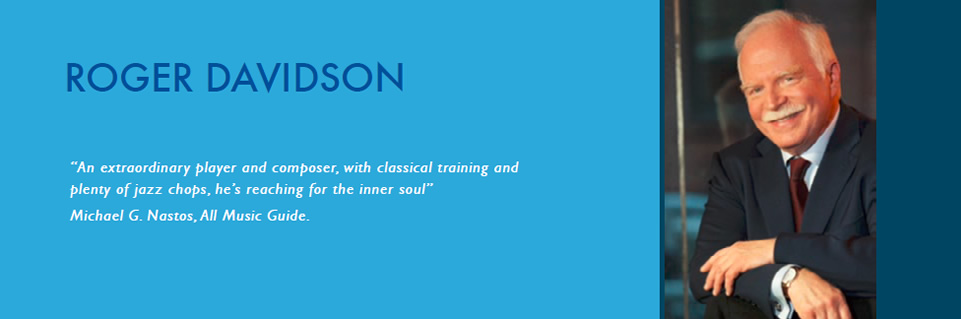
For some artists, music is a means to spiritual enlightenment; for others spirituality is a key element of their musical purpose. But for the eminent composer/pianist Roger Davidson, music and spirituality are inextricably intertwined in his lifelong pursuit of humanism, peace and the illumination of a path for his brothers and sisters to realize the fullest potential instilled in their spirits as children of God. A humanitarian in the purest sense of the word, Roger is also an ordained minister. He founded the Society for Universal Sacred Music in 2000, for the purpose of promoting this message, particularly by emphasizing the unconditional love of God for us all.
Born in Paris in 1952 to a French mother and an American father, Davidson moved to New York when he was a year old, where he started playing piano on his own at age 4, and taking violin lessons at age 8. A self-taught musician, Davidson’s independence and knack for improvising serve him well as a jazz pianist. Formal training in graduate school with David Del Tredici, Theodore Antoniou and others at Boston University, however, gave him a strong background as a skilled composer – which he has expanded into virtually all areas of music.
After graduating from Boston University in 1980 with a master’s degree in composition, Davidson was urged by mentor and early baroque music scholar Sidney Beck to stretch himself beyond his instrumental discipline—Davidson had already led a community orchestra he started in Boston at the time—and enroll in Westminster Choir College in Princeton, where he received a master’s degree in choral conducting in 1985.
At Westminster, Davidson’s love and appreciation for choral music blossomed, and conducting led way to composing for choir – an expression of his personal mission “of creating a repertoire of music to express the unity of God and especially His unconditional love for all humanity,” that would later lead to his coining of the term “universal sacred music”.
Despite this new focus, Davidson’s love of jazz was not lost, and after encouragement by the late Helen Keane, a jazz producer, Davidson worked with bassist David Finck and drummer Dave Ratajczak on his first studio recording and, later on, to active performing. That first recording, in 1991, was released in 2006 as Ten to Twelve on Soundbrush Records, the label Davidson founded in 2002. In his various capacities as the label’s main artist, producer and A&R man, Davidson has developed an impressive roster of hand-picked musicians from around the world and a broad, diverse catalogue that won the label a Latin Grammy™Award. The multi-cultural aspect of Soundbrush Records also relates to Davidson’s overall mission of building spiritual bridges around the world.
Davidson’s sacred music recordings include choral works representing his mission of writing and performing music that builds bridges among people of all faiths and celebrates our fundamental unity: Missa Universalis (1998), One God, One World (2004), and Universal Sacred Music for Chorus (2013) are affirmations of the transcendence that is the substance of his vision. In 2013 he also recorded Temple of the Soul, his masterpiece solo piano recording of rhapsodies and meditations; this recording is an instrumental example of universal sacred music.
In recent years, Davidson became increasingly intrigued by tango, Brazilian music and, klezmer, all styles that have served as wonderful vehicles for the breadth and depth of his emotional expression. His tango explorations as a composer were first documented on Mango Tango (1995), a recording “featuring different kinds of tango, not just Argentine.” Since, he has also recorded Amor por el Tango (2002) and Pasión Por La Vida (2008), a duet with Latin Grammy™ winning Raúl Jaurena, a master of the bandoneón, the button accordion that is the quintessential instrument in tango. His On the Road of Life (2011), a collaboration with klezmer master Frank London, took him to international festivals including the Jewish Culture Festival in Kraków, Poland, playing his original compositions.
Davidson’s life-long love affair with Brazilian music has recently been enhanced by the love of his life, Nilcelia Davidson, who continually inspires a large body of work in this genre. In addition to Rodgers in Rio (2002), a Brazilian-tinged take on Richard Rodgers’ standards, Davidson has released five recordings of entirely original compositions: Bom Dia (2007), Brazilian Love Song (2009), Journey to Rio (2012), a two-volume set recorded in Rio de Janeiro, and two recordings with the harmonica player and vibraphonist Hendrick Meurkens and Roger’s New York City based band: Oraçao Para Amanhã (2017) – a live album, and the forthcoming Music From the Heart (2018). Roger’s publishing company, Musica Universalis, has also published two volumes of Davidson’s Brazilian music in songbook format: To Brazil with Love and Saudade do Brasil. Some of his sheet music is also available here.
In all genres of music with which Roger Davidson has been involved, and regardless of which language or culture, there is one thing that unites them all. In Davidson’s words, “We are all one spiritual family, as we are eternal Brothers and Sisters, regardless of which earthly lifetime we may be in at the present moment. The important thing is to know that there is one spiritual source for us all, and regardless of which country we come from we have that source in common.”
Posted on May 4, 2011
Copyright © 2015 Roger Davidson