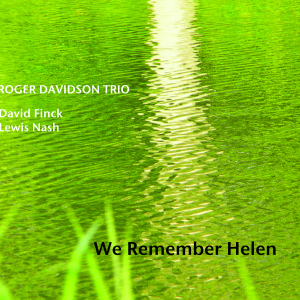
We Remember Helen is a salute to the legendary producer and manager Helen Keane, whose encouragement helped give Roger Davidson the confidence to pursue jazz. In 1991, Keane — best known for her 17-year association with the great Bill Evans — produced Davidson’s first jazz album, Ten to Twelve (Soundbrush Records, 2007).
On We Remember Helen, Davidson is joined by two A-list jazzmen: bassist David Finck (who played on Ten to Twelve) and drummer Lewis Nash. They perform several exquisitely chosen jazz standards that Keane loved (including “Yesterdays,” “Whisper Not,” “How Deep Is the Ocean,” and “What’s New?”), along with originals that Davidson wrote with her in mind. The new project will hit the street on November 6.
Roger Davidson was born in Paris in 1952 to a French mother and an American father. The family moved to New York when he was a year old. He started playing piano on his own at 4, and taking violin lessons at 8. Although he taught himself how to read and write music, Davidson learned to play through improvising, a practice that has served him well as a jazz pianist. He attended Boston University, studying with David Del Tredici and Theodore Antoniou among others, and earning a master’s degree in composition in 1980. After graduating, he studied with early baroque music scholar Sidney Beck. It was at his suggestion that Davidson enrolled at Westminster Choir College in Princeton, New Jersey.
While at Westminster, he also began writing choral music which soon bloomed into the expression of a personal mission and in 2000, he founded the Society for Universal Sacred Music “with the mission of creating a repertoire of music to express the unity of God and especially His unconditional love for all humanity.” Since then, the Society has become a global organization which has already commissioned new works and organized festivals and performances around the world.
After graduating, Davidson spent a summer in Germany, studying voice and teaching improvisation at the Lichtenberger Institute (near Darmstadt). Returning to New York, he unexpectedly reconnected with the late Helen Keane, jazz producer and longtime manager of pianist Bill Evans. Davidson had met Keane while he was a child. She was the mother of a schoolmate and friend. Keane had not only given Davidson his first Evans album, but also gave him a glimpse of another world.
“I was 10 or 11 she took me and her son to recording sessions. I remember we heard Woody Herman, and in another instance also [folk singer] Jo Mapes. Helen was also producing folk musicians then.” The two lost touch with each other, but in 1987, Keane attended a concert by Davidson. “And after the concert she came up and said ‘Nice to see you again. You played really well. How about jazz?’,” recalls Davidson.
“Actually, I’d been listening to jazz since I was a child,” says Davidson. “I loved improvisation and rhythm. I just didn’t think I knew enough.” And by the time Keane reappeared in his life, he had also attended the Stanford Jazz Workshop at Stanford University, Calif., twice: in 1983, when the main teacher was Stan Getz, and 1984, when it was led by Dizzy Gillespie. Keane introduced Davidson to bassist David Finck, and drummer Dave Ratajczak, “and it was like awakening a part of myself that hadn’t been fully awake. I had learned by improvising and jazz is the best musical vehicle for that.” As noted, Finck appears as bassist on the new album.
The informal sessions led to a recording. It was “a trial run,” recalls Davidson, but, the 11 tracks recorded in 1991 were eventually released as Ten to Twelve by Soundbrush Records in 2006, the label Davidson founded in 1997. The name alludes to the initial concept of documenting projects involving visual arts and music. But since, Soundbrush has grown to include an impressive roster of hand-picked musicians from around the world and a broad, diverse catalogue that already has won the label a Latin Grammy. Davidson builds bridges with music and has remained increasingly intrigued by tango, Brazilian and Klezmer music, all styles that elicit, and demand, direct emotional responses.
His tango explorations as a composer were first documented on Mango Tango (1995), a recording “featuring different kinds of tango, not just Argentine.” Since, he has also recorded Amor por el Tango (2002) and Pasión Por La Vida (2008), a duet with Latin GRAMMY winning Raúl Jaurena, a master of the bandoneón, the button squeezebox that is the quintessential instrument in tango. Jaurena won his Latin GRAMMY in 2007 for Te Amo Tango, a Soundbrush Records release.
Davidson has also had a long standing love affair with Brazilian music, sparked by hearing Stan Getz and Gary McFarland’s Big Band Bossa Nova when he was still a child. He has recorded Rodgers in Rio (2005), a Brazilian-tinged take of Richard Rodgers’s standards, Bom Dia (2007), which included some of his own songs, and Brazilian Love Song (2009).
Until We Remember Helen hits the streets, the pianist’s most recent release is On the Road of Life, a collaboration with contemporary klezmer master Frank London and featuring virtuoso clarinetist Andy Statman and master accordionist and cimbalom player Joshua Horowitz.
Catch Roger Davidson’s upcoming live appearances at the Caffe Vivaldi (2 Jones Street, NYC) on Wednesdays September 26 and October 3 at 7:15 p.m. It’s an intimate and classy venue in which to hear Roger Davidson and other Soundbrush Records artists.
____________________________________________________
EXAMINER.com
The Roger Davidson Trio has released a CD titled We Remember Helen. It pays tribute to Helen Keane who was a producer and manager who died in 1996. She persuadedDavidson to play jazz and he did. Jazz opened up a whole new world for him. He would later explore other genres including: Latin music, bossa nova and klezmer. On this latest project, Davidson is joined by David Finck on bass and Lewis Nash on drums.Davidson plays piano.
The disc has 15 songs and it runs a little over 67 minutes. Davidson wrote four songs on the CD and two of them are gospel recordings. They are the two best songs on the album: Dance of Faith and Soul Search.Another gospel tune is Joshua Fought the Battle of Jericho. It is a piano-drums duo featuring Roger Davidson and Lewis Nash. Most of the songs are slow tempo until you get to the previously mention gospel songs and Waltz for Debby. There are also some songs from the Great American Songbook including: Early Autumn and All The Things You Are.
The CD is filled with wonderful music and superb palying from Davidson on piano, Lewis Nash on drums and David Finck on bass. Nash has played with Sonny Rollins, Oscar Peterson, Betty Carter and Horace Silver. Finck has worked with Herbie Hancock, Dizzy Gillespie, Rosemary Clooney, Andre Previn and Michel Legrand. That is quite a diverse group. The trio all came together and made this a very enjoyable CD. It is one I'll be listening to again and again.
By Oscar Brooks
http://www.examiner.com/review/roger-davidson-trio-we-remember-helen